Fluffy the Frilled Dragon eats a frozen fuzzy mouse. Slow-motion pounce at the end of the video. For more please visit his YouTube channel FluffyFrilledDragon
Showing posts with label frilled dragon. Show all posts
Showing posts with label frilled dragon. Show all posts
Friday, March 9, 2012


Monday, March 5, 2012
Friday, March 2, 2012
Thursday, March 1, 2012
Heating The Habitat

An IR Fusion view of Troy holding fluffy.

Fluke Tis Handheld Infrared Camera
As I was saying we analyzed the output of the lights in the cage and were surprised at how warm not only the lamps were but the materials around the lamps were as well. Here are the results from our initial inspection of the lamps with the infrared camera:

An IR Fusion view of the lamps left to right: Night Heat Lamp, Basking Lamp, Red Heat Lamp, Basking Lamp, Night Heat Lamp.

Infrared view images of Lamps showing a range between 80 and 200° F
Here is an image of the wood above the lamps showing the extreme heat that was building up underneath the plywood top of the cage:
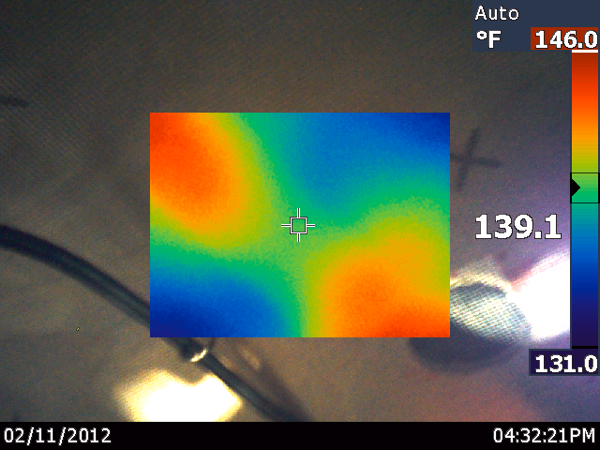
An IR Fusion view of the ceiling of the cage before adding insulation. Screen material under the ceiling.
What we did was to add this bubble foil insulation that we cut down to size and stapled to roof of the cage. Any hardware store sells this material, it usually comes in a roll and can be kind of expensive if you only need a small section of material to insulate. But it's worth being able to sleep at night knowing the cage is protected from the buildup of heat.

Bubble foil insulation available at any hardware store.
As you can see below we cut several strips of material and stapled it to the top of the cage:

An view of the ceiling of the cage after adding insulation.
After installing the insulation we rechecked the buildup of heat with the IR camera both above and below the top of the cage:
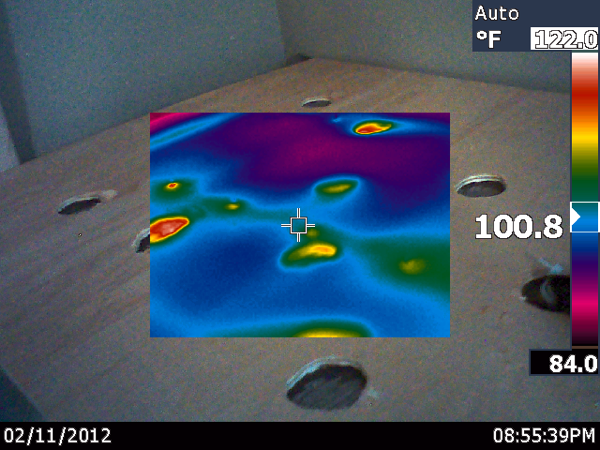
An IR Fusion view of the roof of the cage after adding insulation.
Top of the cage with the IR Fusion Mode to show a the top of the cage was averaging 100° F.
The red and white hotspots show the heat of the insulation on top of the bubble foil material, exposing the plywood to a max of 122° F. This technique of using this bubble foil material effectively lowered the exposed heat to the plywood by about 30° F. You can note that in the images above this one before this material was added the wood was being exposed to temperatures of about 150° F.
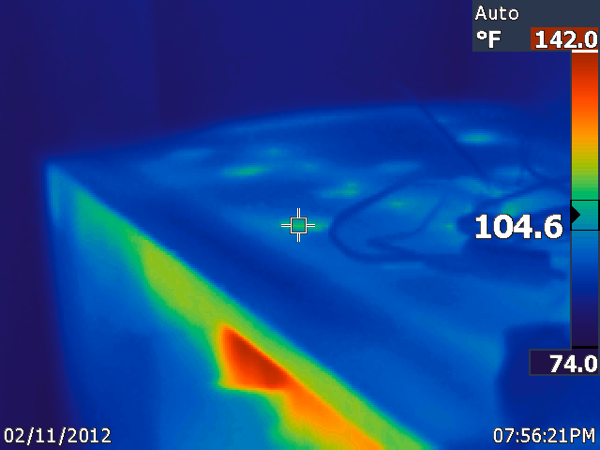
An IR Fusion view of the roof of the cage after adding insulation.

An IR Fusion view of the top insulating material of the cage.
We use the IR camera to inspect how well heat was reaching the bottom of the cage as well as whether or not it was allowing for a gradient of heat to allow the animals to move to different areas of the cage to cool off or warm up.

An IR Fusion view of the top of the cage.
We also needed to check and see how the bottom of the cage held the heat as it was about 5 feet from the lamps at the top of the cage and one side of the cage was just a screen material that allowed heat to escape from the front of the cage.

An IR Fusion view of the bottom of the cage.
We also have to consider the fact that the frilled dragon can climb and likes to hang off of branches so the entire cage is accessible to him, unfortunately the bearded dragon does not climb higher than a foot or so off the ground. We had to provide him with another source of heat if he wishes to be warmer. We added a rock heater underneath some of the bedding:

Standard heat rock available at any pet store.

Bottom of Cage Rock Heater underwent substrate.
The rock heater allow the bearded dragon to warm up in an area that is nearly 90° F which is much better for him.We're continuing to work on this habitat, we're considering ways in with we can provide the bearded dragon more direct access to the basking lamps. Right now we're working on building a series of ramps he can climb to get closer to the lamps. When we make those changes we'll post about them. We considered lowering a basking lamp on a wire from the top of the cage, however we were concerned that fully could try to jump from his branch or from the screen and try to land on the top of a lamp, since those lamp fixtures can reach as high as 250° F we were convened that he could jump on them and burn himself, so rather than take the lamps to the lizards we'll have to engineer a way to bring the lizards to the lamps.
Now fluffy enjoys hanging on his branch or climbing the screen to bask in the heat.

Fluffy hanging by and basking on his branch.
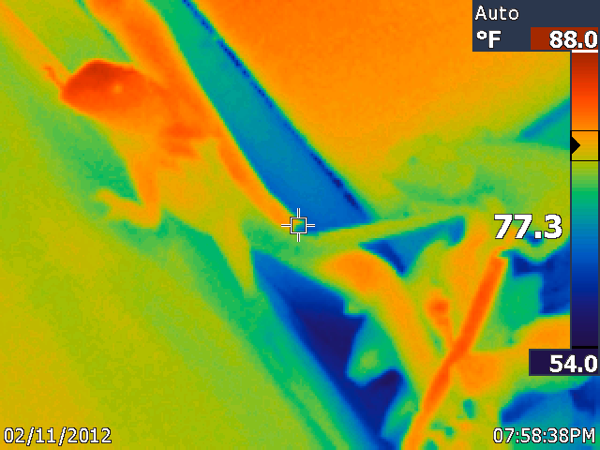
Fluffy hanging on the screen about a foot above the floor of the cage, beau is behind him in green.
This image shows that fluffy's skin is about 85° F, while Bo the bearded dragon is about 80° F. The infrared cameras as a fascinating way to see how cold blooded animals react to temperature when they choose to bask or cool off.
Monday, February 13, 2012
Update…Cohabitation
First sorry that we haven't updated the blog in quite some time, things have been busy since our last posts, we've moved, one of our lizards (Bo the bearded dragon) that was being fostered with a friend since our house burnt down has came back home to us.
We've moved out of the hotel in which we were temporarily living and both lizards have came back to live with us. Previously both Fluffy (the Frilled Dragon) and Bo (the Bearded Dragon) were housed sepiratly each in their own 50 gallon tank on a wire baker's rack. We've taken the time to put together their own habitat so they can have a larger place to live, together.
Cohabitation of a Bearded and Frilled Dragon
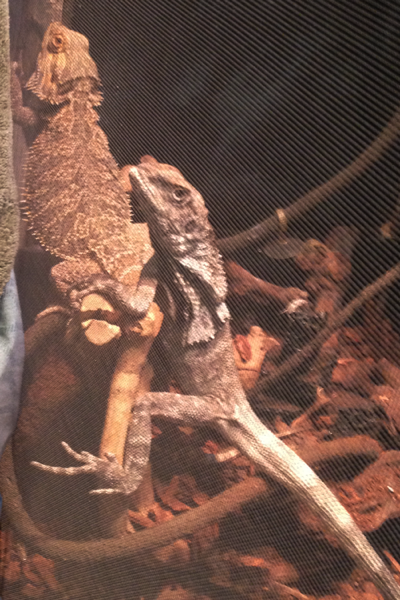
I realize that there are a lot of people say that it's not a good idea to house heterogeneous species of lizards together and that lizards should only cohabitate if they're of the same species and mixed genders or are exclusively juveniles. In our case Bo is an 8 year old bearded dragon, Fluffy is almost two years old, he's growing out of his juvenile lizard phase. In most cases one should worry about the bearded dragon being hostile towards other lizards because their venomous and can have an aggressive attitude. Other concerns is providing an environment that is suitable to house two species. A desert animal should never be housed with a rainforest animal because it is impossible to create an environment that provides suitable humidity, a humid environment will kill a desert creature by way of respiratory infection, a dry environment will kill a rain forest creature through lack of proper hydration. Additionally different animals have different kinds of bacteria. An iguana's bacteria can kill a bearded dragon just from transmitting bacteria.
In our case we felt comfortable with both our lizards cohabitating because of analyzing the following factors:
Habitat
Frilled dragons and bearded dragons come from the same habitat more or less. They both come from Australia/New Zealand in the outback which is kind of a desert/forest kind of habitat and therefore can live in a blended desert/forest environment. The frilled dragon is more suited to climbing trees and anything else they can get their hooks into. While the bearded dragon prefers to bask and chill out near the floor or proper against a rock or branch. When Fluffy was a juvenile there was a lot of misinformation in pet stores on the internet regarding humidity requirements, a lot of people insisted that they required a lot of humidity, others with experience raising frilled dragons will say that humidity is less of a concern and too much can can cause respiratory problems. We were very careful to provide a moderate level of humidity, the only thing it helps is when he sheds. When his body is wetter he doesn't seem to be as irritated when shedding. For a long time we used a mister to create a gradient of high/low humidity in his cage 40% humidity in the high end. At that time we rationalized that his natural environment was more of a forest environment with higher humidity. In hind sight it was completely un-necessary, the only thing that helped him was having flowing water from a waterfall to drink on occasion, and a large bowl of water "the lizard jacuzzi" to soak in on occasion and wet his skin when shedding. Otherwise misting or adding humidity was completely un-necessary.
Biocompatibility
Another concern is disease and bacteria. I'm not an expert on biology but I read elsewhere that in the case of housing Bearded Dragons and Iguanas was a really bad idea because Iguanas carry bacteria that is fatal to bearded dragons. In our case because fluffy and bo are from similar classes in the animal kingdom and similar habitats, the risk of disease from cohabitation was negligible and a risk worth taking. We felt that it was inhumane to house these creatures in separate smaller habitats and that allowing them to live in a larger habitat with little risk of disease was a risk worth taking. So far it has paid off, both animals are at greater eases and likely from having a larger habitat dispute the fact that they share it with each other.
Temperament
Both dragons get along (a year or so ago they did not but now they don't mind each other), the bearded dragon has a very calm temperament, over the years we have hand fed him, he has interacted with our other animals, cats & dogs, nothing scares him, nothing seems makes him aggressive not even other reptiles. On the other hand the frilled dragon has always been a bit more feisty, but his temperament has changed significantly in the course of a year or so. He's now more docile, he isn't territorial as he was. Previously he was a bit more aggressive in his 50 gallon tank on account of having a small habitat. Now that both animals have a larger habitat they're both more content to enjoy basking, hunting for crickets and even playing to an extent. Fluffy the frilled dragon has not shown any aggressive behavior other than on limited occasion jumping on or crawling over the bo the bearded dragon when moving around the cage.
Also for the most part because the cage is so large both lizards have their own areas of the habitat they live in. The frilled dragon who's species is adept to climbing enjoys hanging off of logs and screen material towards the top of the cage. While the bearded dragon hangs out either in his pink hide house, on his basking rocks, or on top of his pink hide house at the bottom of the cage. He's a bit older and he doesn't attempt to climb to the top of the cage. He could he he wanted to but chooses not to.
Final Word
When considering whether or not to allow two lizards to cohabitate it's very important that you consider the health of both animals before doing anything. I'm the kind of pet caretaker that is very attune to my animals. Additionally I did a lot of research to determine whether or not this was appropriate to house my animals together and considered a variety of factors and risks before entertaining such an idea. Finally I tailored the construction of the cage to cater to the needs of both animals before allowing the two to live together. This worked in my case but if you're looking to do the same thing I strongly suggest consulting a vet, doing a lot of research and not to rush in to such an endeavor and closely monitor the health and wellbeing of both animals before and after doing this. I have and was successful in my case.
Soon to come...
Store bought animal habitats are often just overpriced crap, we know this from years of experience. We will post later regarding the design and construction of our lizard habitat and share photos and information that can help you design and build your own lizard habitat.
Fluffy's Home is Under Construction
Recently we've built a new home for Fluffy, he now lives in his new cage with our bearded dragon, Bo. We are working hard on getting the fluffy cam back online since his home went under construction and we will be adding a blog about his move from his previous 50 gallon cage to his new large custom built home.
Sunday, April 24, 2011
april 24 2011 weight
Fluffy now weighs 178grams. He has almost grown 100grams from his last weigh in.


I did take out Fluffy's rocks and clean them mixed his substrate around and water his plants. Here are some pictures of our boy!
Sunday, March 6, 2011
WAYS TO GET YOUR FRILLED DRAGON
There are many ways to get your frilly. You can check with a pet store. Pet stores are 3-4 times removed from the breeder, (and as i found out) and may not be able to answer your questions. You can get your frilly from a reptile dealer. Or you can get your frilly from a reliable breeder. I feel this is the best way if you want to know the best information about frilled dragons. They can tell you about the bloodline, how to care for your frilly and what to look for in a frilly. Now when ordering from a breeder there are two way to get your frilly from them. First way is to drive and pick your frilly up right from the breeder. The other way is to have them Air shipped to you. the following are some helpful tips on having your frilly shipped to you:
- Most breeders ask that you pay in advance, either by credit card with, money order, or cashier check.
- Not likely, some breeders may accept C.O.D.‘s. C.O.D.’s are more expensive. Most breeders do not offer this as an option.
- Give the breeder your full name, address, and phone number where you can be reached.
- Let the breeder know what airport you would like to use, or agree on door to door delivery.
- Get the shipping date. On that shipping date call the breeder and get the air bill number, avoid weekend shipping most cargo offices are closed.
- Most shipping takes 24 hours (Airport to Airport)
- If you can, try to keep your frilly on the same airlines. You have to pay extra for each airline you use.
- Ship only in good weather.
- There are 3 types of shipping option;
- Freight~ Basic, most used
- Air express~ guaranteed flights
- Small package~ fast level of service
The last two you will pay more, so compare Airlines.
- Don’t be afraid to call the airport and check the status of your frilly. You will need the air billing number, this will help the airline track your frilly.
- Pick up your frilly as soon as it arrives at the airport, especially if the weather is bad. Get the cargo office hours. Make arrangements to pick up your frilly at the ticket counter if the cargo office is closed.
- Once Airline verifies that payment has been made, check out your frilly before you leave the airline. Reliable breeders guarantee live delivery.
- If something is wrong, you will need to fill out a “Discrepancy” or “Damage” report. Get it signed and dated, before leaving the airlines. Insist on filing the claim form at this time. Get a claim number.
- Call the breeder right away.
I hope this information will be helpful in your search. Happy hunting....
Sunday, February 27, 2011
Frilled dragon care. UPDATED
Fluffy Care....
Updated
Housing~ When housing your frilly space is important. Hatchlings could be in a tank 20+ gallons, juveniles should be housed in a 55-75 gallon tank, adults NEED to be housed in a 3’x3’x4’ (lxwxh) enclosure. Your Frilled Dragon enclosures should be easy to wipe down. I find glass works the best. You can use anything that works for you! Because this is for you and your Frilly.
~ Remember ventilation is NEEDED your Frillies home. Along with a door that is easy for you to get your Frilly in and out. Please make sure that you have it so your Frilly CANNOT get out!!! So if need be add a lock! Add branches for climbing, but keep in mind that you will need to keep them away from the heat source! (You don’t want your frilly to burn themselves!!!!)
Lighting~ Correct lighting is VERY IMPORTANT!!!Frillies like most reptiles NEED ultraviolet (UV) lighting both UVA and UVB.
UVA~ stimulates appetite, encourages activity, and helps with breeding behaviors in your frilly...
UVB~ is vital for synthesis of vitamin D3, regulating your frillies calcium, and balancing calcium and phosphorous levels...
I personally use what is called full-spectrum fluorescent to get the benefits of both UVA and UVB. these lights should be changed after nine (9) months. Even if they still work! Full-spectrum fluorescent over time loses the UV output!
FYI~ I find that 12 hours on & 12 hours off will help with your frillies personality/behavior.
~ Some people like use back lights keep in mind they do NOT put out UVA or UVB! that does not mean you cant use them as a night light. I use them, they do have a nice visual effect.
~Don’t forget a basking spot....
Terrarium/Vivarium Layout~ One thing to keep in mind is a hiding area. Sense frillies like to spend their days in tree as well as ground you will want to put some vertical branches in their home. also frillies do startle easy, so i find it better to cover 3 sides of the enclosure. It is also important to have substrate that goes well with your Frilly. Because that Frillies are forest lizards I would recommend compressed coconut fibers, chopped wood, (it comes in many verities, sizes, and colors). Other thing that you can add for your Frillies enclosure are branches and plants...
Branches~ Add branches for climbing, but keep in mind that you will need to keep them away from the heat source! (You don’t want your frilly to burn themselves!!!!)
Plants~ Keep in mind that your Frilly may eat your plants or as I found out Fluffy, (Our Frilly) will climb over the plants that we have added. He never goes around them. Do some research before you put plants in some plants are not good for them, ( I’m still researching this for myself.)
Feeding~ There are many types of diets that you can feed your Frilly. I have done some reading and they say that you can feed your Frilly canned cat food but I have not tried this, and it sounds a little fishy to me, (no pun intended). Others have had luck feeding fruits, and vegetables. Her is a list of safe food.
~ Alfala,
~ Apples,
~ Berries (straw, blue, elder),
~ Broccoli (stems,and leaves),
~ Bok choy,
~ Cabbage (dark green, and red. NEVRE white), ~ Dandelions,
~ Escarole,
~ Grated roots (carrots, beats)
~ Grated squash,
~ Greens(turnips, collards, mustards, beats),
~ Hibiscus (blooms, and leaves),
~ Leaf lettuce,
~ Melons,
~ Nastrutrum,
~ Okra,
~ Papaya,
~ Peaches,
~ Pears,
~ Romaine,
~ Rose petals,
~ Tofu,
~ Tomato.
When trying this cut them small enough for them to eat. You can tell if they are small enough, by cut them to the with of there eyes. if you have question go a head and email me, and if you think it is still to big then go a head and cut them smaller! If you try to feed look into what you feed him. Thing like rhubarb can not been fed to your Frilly. Other thing you can feed Frillies are meal worms, wax worms, and crickets. They come in many sizes. keep in mind eyes width. Also try wax worm if your Frilly get sick. The wax worms will help get his appetite back to what it should be. Be careful wax worms are high in fat, so done feed them to often. or just as a treat. Fluffy only eats gut loaded crickets. It’s not like I haven’t tried others foods, I have! Fluffy is just a picky eater. I am using re-hydrated vegetable medley mix in there, but the crickets eat that. Don’t worry if Your frilly does not eat fruits and veggies. From what I read it’s not that uncommon.
FYI~ Every other feeding you will want to dust you live food with calcium powder.
General Care~ Frillies may grow to be three (3) feet long, and depending on there age and size you may have to change the way you pick them up. When they are small you may want to lead them into a plastic container. As they grow older/larger use both hands cupped to catch them. If you let your frilly roam free time to time. trying to catch them can be hard, frilled dragons can run fast. you may want to use a blanket to catch them, try not to chase them because chasing can be stressful on your frilly, and it could be fatal.
Shedding~ Frillies do shed, don’t worry about this it’s natural, it’s just old skin need to come off. However they should be handled less during the shedding process. You may be tempted to help them shed by pulling the dead skin off however it is best that they shed on their own. Raising the humidity levels may help the process.Fluffy does get pissy when he sheds, and a temperament change is natural during the shedding process.
Cleaning~ Once a week I take out water bowl, and feeding dishes. Put on gloves and pick up Fluffy poop,and Fill Fluffy’s waterfall. (you may want to remove any dead crickets). Once a month I take branches, vines, and foliage out and and disinfect them (I use the dishwasher). Every three months you need to replace your frillies substrate, and do a deep cleaning.
If you have any questions feel free to contact me at: dont.frill.up@me.com
Friday, January 7, 2011
Frilled dragon care info
Because information on the internet seems sparse in regards to Frilled Dragons, I'm going to post what I believe is correct for maintaining one of these creatures in an indoor enclosure. I'm in Iowa where it's dry and cold in the winter and warm and humid in the summer. Keep in mind where you're located because when the humidity changes in your area it's important to adjust your Frilly's humidity and temperature to keep it comfortable for him or her.
Temperature & Humidity
Temp. 100 degree F, in the basking side of the enclosure. 70-80 degrees on the cool side. Humidity 50- 70%. It's important to have a large gradient (warm air in one part of the cage room temperature in another) It's also important to have a gradient in regards to humidity, the lower end of the thank can be more humid and the top of the thank can be dry.
Your Frilly will pick a spot to sit based on where it's most comfortable to him or her. These animals live in trees where it's natural to have temperature and humidity gradients. They're also similar to bearded dragons which live in deserts so it's important to have dry humid air. Because there is a lot of information out there on temperature and humidity and there are no authoritative resources regarding caring for these creatures we believe that it's best to setup a habitat that offers different areas for all climates and humidities. But keep in mind that your Frilly will also hang out where he or she tends to feel the most secure, as loving as they seem they become scared and frightened very easy. For that reason we have wrapped the back and side of his cage with black paper to make him feel more secure. We have also placed faux vegetation in front of his cage to allow him to hide which makes him more comfortable and secure.
In talking with many people who have kept Frillies as pets the common problem for mortality in juvenile frilled dragons is respiratory infection. Many believe that this is cause by excess humidity. We've seen authoritative resources state that these animals are from jungles and forests where there is a moderate uniform level of humidity towards the floor of the echo system. Unfortunately in a tank it's very hard to reproduce that environment because it's a very small echo system, we try to deal with this by minimizing the fog and humidity and we augment the humidity with water falls and standing water under infrared light. This causes a more diffused and natural humidity. The problems with humidifiers from pet stores and the spray bottle method is that it introduces larger droplets in the air. This problem will cause respiratory infections get in to the tiny lungs of these creatures and cause infection. That's why we avoid misting, only use a humidifier or fogger on it's lowest setting and use heating lamps to evaporate water. This will end up with smaller particles of water in the air and will help avoid death from respiratory failure caused by excessive fogging or spraying while maintaining an acceptable level of water particle density that isn't harmful to the frilly.
Heating & Equipment
I use two day heat lamps during the day and a night heat lap on 24/7. I also have two full spectrum lights and a black light that i run at night for a cool night light for fluffy it doesn't seem to bother him. So it working and it aids in the web cam. I will post a video of the lighting and the set up at a later date.
Diet
Im having the best luck with the crickets, I also put Healthy Herp Veggie Mix Instant Meal reptile food. it beats cutting fresh veggies up every day Fluffy has not o my knowledge eat any yet but the cricket have and it keeps them alive so it is worth the $20. Other food you can try are wax worms in small doses,cause of the fat content. as the get older you can try baby mice and rats even pinkies. For veggies you can try collard greens,red leaf lettuce, mustard greens, turnips greens, dandelions greens. stay away from spinach, cabbage, large amounts of kale. You can also try carrots, squash, sweet potatoes, peas, corn, and fruits in small doses. Keep in mind not all frilled dragons will eat veggies!!!
when feeding your frilly crickets dust them with a calcium d3 dust you can get that at any pet store. when you feed crickets gutload them. Don't feed them insects from outside cause of pesticides that they may carry. they may kill you frilly!!!!
Substrate & Water Needs
I use a waterfall and I have a water dish for him to soak in, he does drink out of the water fall i find that neat. Substrate can be news paper, wheat brand, and cyprus mulch or soil. once again keep in mind of chemicals. will be dangerous and deadly to your frilly.
Lighting & UVB
Brighter the better. Full spectrum UV source are the best for your frilled. that is why i have two of these bulbs. if the weather is at idea temp &humidity you can let them out to play let them get the real thing it truly is the best.
Sexing & Characteristics
Ok this is not easy to do. as a rule of thumb. Male are larger and and have more color. frills are also larger, and males are less skittish.
Cleaning & and Maintenance
I clean fluffy cage once a week and deep clean once a month, water every day. When you first get your frilly take him to the vet don't just take your pet store a ok on his health. I found that out the hard way!!!
Tomorrow i will try to find out behavior and personality on the frilled dragons!
Tuesday, January 4, 2011
Sunday, December 26, 2010
Monday, December 20, 2010
Weekly cleaning
Tonight I took out everything and wash them, and sifted the sand. I Think I will be using distilled water for here on out the water spots on the side of the tank are a pain to clean. I even took his waterfall out to be cleaned. I did add a black light for a cool night effect. It makes his sand glow green. I enjoy it and he seems to sleep without it bothering him, so I think it is all good. I'm still trying to get him to eat veggies. That is not going well, but I'll keep trying. The only thing I found that he will eat is crickets, and that is funny he is clumsy and his aim is off so he will miss when he goes after them. That is why I enjoy him so much. He is kinda like me, clumsy.
I did find a vet in Des Moines that has dealt with frilled dragons. I'm going to be making an appointment with oaks vet clinic. we'll see how they do...
Monday, December 13, 2010
Fluffy pictures, and Vet visit...

The vet did not have a lot to tell me because this was his first encounter with a frilled dragon. What he did say is that Fluffy is about two months old and is under weight. The vet also said that humidity should be at 50 to 60%, and should never get over 75%.
I also emailed a zoo in Australia to see if they would be kind enough to share any information that would be helpful in regards to housing a frilled dragon. I hope to hear something from them soon. I'm also going to try to call the San Diego Zoo, along with the Bronx Zoo to see if they can help me.
Here are some pics of Fluffy's new habitat:


Sunday, December 12, 2010
Temp and Humidity & Fluffy

last night I went to pet smart to get the last (I hope) of the things I needed for Fluffy I have added a fogger by ZooMed, more vines to climb on, more greenery, (you could get your greenery from a craft store if they use non-toxic chemicals). In Iowa I would have to say Pet Smart has the best selection for reptile, HANDS DOWN. Now keep in mind I did not get any information from their employees, nor did I ask. And that is only my opinion!!! If u live in Des moines Iowa and you have had problems with Pet Smart and you are a Petco fan I do suggest that you go to the Jordan Creek store and ask for Daniel, he works during the day, he knows his stuff. If he don't he will tell you and not make it up like the other guy that works in the Reptile dept.
Temp. and Humidity
Today I had to work so I was not able to monitor it all day but tonight I did some fine tuning, and still have to work at it, but at this point I'm still not sure how high the humidity level should be? (Tomorrow Fluffy will go to the vet, and at that time I will ask the vet at that point)
I'm having some problems I cant get the temp past 90 degrees. fluffy is in a 30gallon tank, with two 100 watt heat lamps, and a full spectrum light during the day. Also a black heat lamp at night, and a 30 gallon under tank heating mat. I'm starting to think that it could be the temp gage. not sure. tonight the temp is at 80 degrees, which is good i think. The temp should never get below 70 degrees!!! (that information came from the petco web site.) So take it for what it is worth. Like I said, I will have more true information for a reptile vet.
And now more on Fluffy
He didn't move much till I got home from work. When I got from work I held Fluffy. He did his thing for and hour then he climb up. He has been there all night . He turns his head and looks around a lot. My guess is that he is still getting use to his home. He has not jumped in the water but is enjoying the mist hitting his body.
Saturday, December 11, 2010
Fluffy was brought home 12/10/2010
Last night I was surfing the web to find myself a pet. I came across a pic of a frilled dragon.... I fell in love. and before I even know where to get one, I had his (well for now fluffy is a male, we will find out later!!!) name picked out. I will get pictures on here later today... Fluffy is about 7-8 inches. he is pretty docile, and friendly. I think that is a lot to do with he is in a new loving home!!! more tomorrow...
I couldn't do this with out the help of Piggy.... Thanks for all your help!!!!
Subscribe to:
Posts (Atom)