Our First Video - Fluffy and Bo Sharing Mealworms
Showing posts with label cohabitation. Show all posts
Showing posts with label cohabitation. Show all posts
Friday, March 2, 2012


Thursday, March 1, 2012
Heating The Habitat

An IR Fusion view of Troy holding fluffy.

Fluke Tis Handheld Infrared Camera
As I was saying we analyzed the output of the lights in the cage and were surprised at how warm not only the lamps were but the materials around the lamps were as well. Here are the results from our initial inspection of the lamps with the infrared camera:

An IR Fusion view of the lamps left to right: Night Heat Lamp, Basking Lamp, Red Heat Lamp, Basking Lamp, Night Heat Lamp.

Infrared view images of Lamps showing a range between 80 and 200° F
Here is an image of the wood above the lamps showing the extreme heat that was building up underneath the plywood top of the cage:
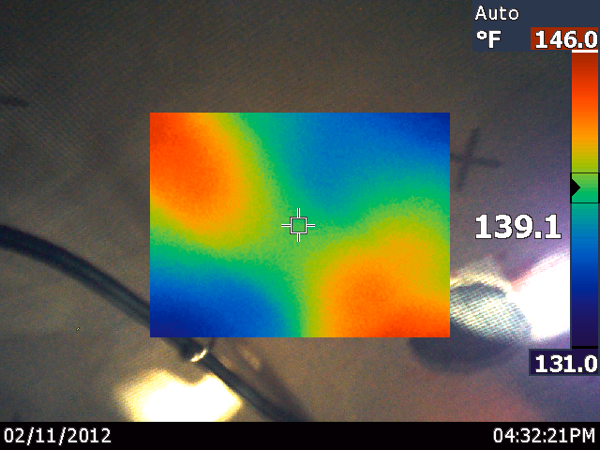
An IR Fusion view of the ceiling of the cage before adding insulation. Screen material under the ceiling.
What we did was to add this bubble foil insulation that we cut down to size and stapled to roof of the cage. Any hardware store sells this material, it usually comes in a roll and can be kind of expensive if you only need a small section of material to insulate. But it's worth being able to sleep at night knowing the cage is protected from the buildup of heat.

Bubble foil insulation available at any hardware store.
As you can see below we cut several strips of material and stapled it to the top of the cage:

An view of the ceiling of the cage after adding insulation.
After installing the insulation we rechecked the buildup of heat with the IR camera both above and below the top of the cage:
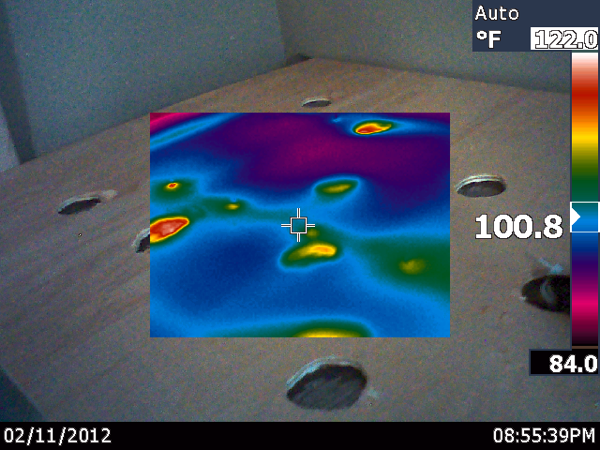
An IR Fusion view of the roof of the cage after adding insulation.
Top of the cage with the IR Fusion Mode to show a the top of the cage was averaging 100° F.
The red and white hotspots show the heat of the insulation on top of the bubble foil material, exposing the plywood to a max of 122° F. This technique of using this bubble foil material effectively lowered the exposed heat to the plywood by about 30° F. You can note that in the images above this one before this material was added the wood was being exposed to temperatures of about 150° F.
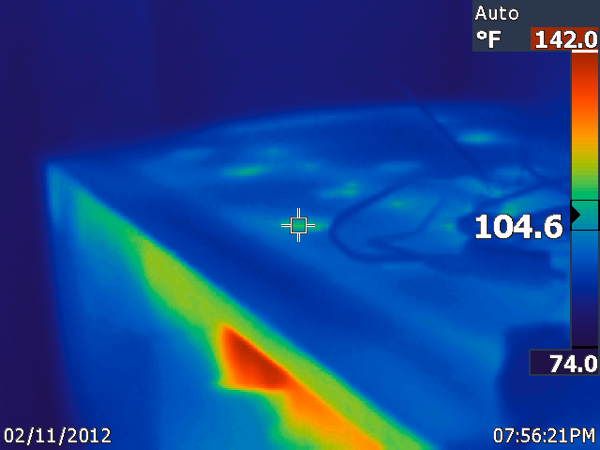
An IR Fusion view of the roof of the cage after adding insulation.

An IR Fusion view of the top insulating material of the cage.
We use the IR camera to inspect how well heat was reaching the bottom of the cage as well as whether or not it was allowing for a gradient of heat to allow the animals to move to different areas of the cage to cool off or warm up.

An IR Fusion view of the top of the cage.
We also needed to check and see how the bottom of the cage held the heat as it was about 5 feet from the lamps at the top of the cage and one side of the cage was just a screen material that allowed heat to escape from the front of the cage.

An IR Fusion view of the bottom of the cage.
We also have to consider the fact that the frilled dragon can climb and likes to hang off of branches so the entire cage is accessible to him, unfortunately the bearded dragon does not climb higher than a foot or so off the ground. We had to provide him with another source of heat if he wishes to be warmer. We added a rock heater underneath some of the bedding:

Standard heat rock available at any pet store.

Bottom of Cage Rock Heater underwent substrate.
The rock heater allow the bearded dragon to warm up in an area that is nearly 90° F which is much better for him.We're continuing to work on this habitat, we're considering ways in with we can provide the bearded dragon more direct access to the basking lamps. Right now we're working on building a series of ramps he can climb to get closer to the lamps. When we make those changes we'll post about them. We considered lowering a basking lamp on a wire from the top of the cage, however we were concerned that fully could try to jump from his branch or from the screen and try to land on the top of a lamp, since those lamp fixtures can reach as high as 250° F we were convened that he could jump on them and burn himself, so rather than take the lamps to the lizards we'll have to engineer a way to bring the lizards to the lamps.
Now fluffy enjoys hanging on his branch or climbing the screen to bask in the heat.

Fluffy hanging by and basking on his branch.
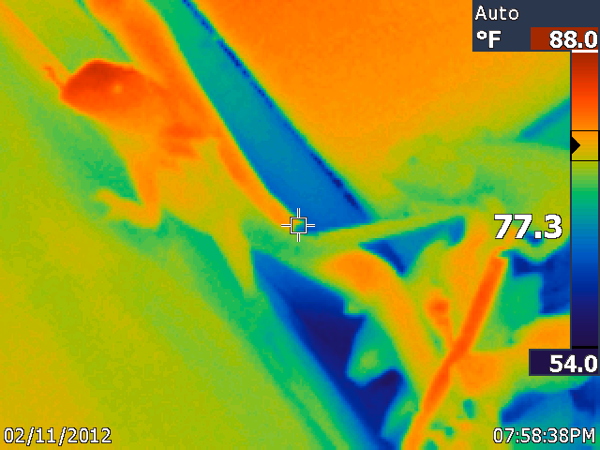
Fluffy hanging on the screen about a foot above the floor of the cage, beau is behind him in green.
This image shows that fluffy's skin is about 85° F, while Bo the bearded dragon is about 80° F. The infrared cameras as a fascinating way to see how cold blooded animals react to temperature when they choose to bask or cool off.
Monday, February 13, 2012
Update…Cohabitation
First sorry that we haven't updated the blog in quite some time, things have been busy since our last posts, we've moved, one of our lizards (Bo the bearded dragon) that was being fostered with a friend since our house burnt down has came back home to us.
We've moved out of the hotel in which we were temporarily living and both lizards have came back to live with us. Previously both Fluffy (the Frilled Dragon) and Bo (the Bearded Dragon) were housed sepiratly each in their own 50 gallon tank on a wire baker's rack. We've taken the time to put together their own habitat so they can have a larger place to live, together.
Cohabitation of a Bearded and Frilled Dragon
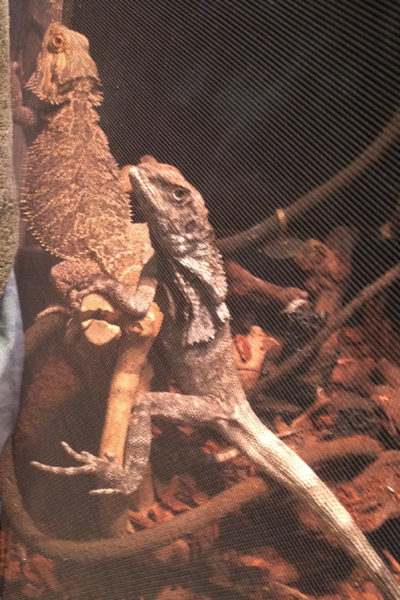
I realize that there are a lot of people say that it's not a good idea to house heterogeneous species of lizards together and that lizards should only cohabitate if they're of the same species and mixed genders or are exclusively juveniles. In our case Bo is an 8 year old bearded dragon, Fluffy is almost two years old, he's growing out of his juvenile lizard phase. In most cases one should worry about the bearded dragon being hostile towards other lizards because their venomous and can have an aggressive attitude. Other concerns is providing an environment that is suitable to house two species. A desert animal should never be housed with a rainforest animal because it is impossible to create an environment that provides suitable humidity, a humid environment will kill a desert creature by way of respiratory infection, a dry environment will kill a rain forest creature through lack of proper hydration. Additionally different animals have different kinds of bacteria. An iguana's bacteria can kill a bearded dragon just from transmitting bacteria.
In our case we felt comfortable with both our lizards cohabitating because of analyzing the following factors:
Habitat
Frilled dragons and bearded dragons come from the same habitat more or less. They both come from Australia/New Zealand in the outback which is kind of a desert/forest kind of habitat and therefore can live in a blended desert/forest environment. The frilled dragon is more suited to climbing trees and anything else they can get their hooks into. While the bearded dragon prefers to bask and chill out near the floor or proper against a rock or branch. When Fluffy was a juvenile there was a lot of misinformation in pet stores on the internet regarding humidity requirements, a lot of people insisted that they required a lot of humidity, others with experience raising frilled dragons will say that humidity is less of a concern and too much can can cause respiratory problems. We were very careful to provide a moderate level of humidity, the only thing it helps is when he sheds. When his body is wetter he doesn't seem to be as irritated when shedding. For a long time we used a mister to create a gradient of high/low humidity in his cage 40% humidity in the high end. At that time we rationalized that his natural environment was more of a forest environment with higher humidity. In hind sight it was completely un-necessary, the only thing that helped him was having flowing water from a waterfall to drink on occasion, and a large bowl of water "the lizard jacuzzi" to soak in on occasion and wet his skin when shedding. Otherwise misting or adding humidity was completely un-necessary.
Biocompatibility
Another concern is disease and bacteria. I'm not an expert on biology but I read elsewhere that in the case of housing Bearded Dragons and Iguanas was a really bad idea because Iguanas carry bacteria that is fatal to bearded dragons. In our case because fluffy and bo are from similar classes in the animal kingdom and similar habitats, the risk of disease from cohabitation was negligible and a risk worth taking. We felt that it was inhumane to house these creatures in separate smaller habitats and that allowing them to live in a larger habitat with little risk of disease was a risk worth taking. So far it has paid off, both animals are at greater eases and likely from having a larger habitat dispute the fact that they share it with each other.
Temperament
Both dragons get along (a year or so ago they did not but now they don't mind each other), the bearded dragon has a very calm temperament, over the years we have hand fed him, he has interacted with our other animals, cats & dogs, nothing scares him, nothing seems makes him aggressive not even other reptiles. On the other hand the frilled dragon has always been a bit more feisty, but his temperament has changed significantly in the course of a year or so. He's now more docile, he isn't territorial as he was. Previously he was a bit more aggressive in his 50 gallon tank on account of having a small habitat. Now that both animals have a larger habitat they're both more content to enjoy basking, hunting for crickets and even playing to an extent. Fluffy the frilled dragon has not shown any aggressive behavior other than on limited occasion jumping on or crawling over the bo the bearded dragon when moving around the cage.
Also for the most part because the cage is so large both lizards have their own areas of the habitat they live in. The frilled dragon who's species is adept to climbing enjoys hanging off of logs and screen material towards the top of the cage. While the bearded dragon hangs out either in his pink hide house, on his basking rocks, or on top of his pink hide house at the bottom of the cage. He's a bit older and he doesn't attempt to climb to the top of the cage. He could he he wanted to but chooses not to.
Final Word
When considering whether or not to allow two lizards to cohabitate it's very important that you consider the health of both animals before doing anything. I'm the kind of pet caretaker that is very attune to my animals. Additionally I did a lot of research to determine whether or not this was appropriate to house my animals together and considered a variety of factors and risks before entertaining such an idea. Finally I tailored the construction of the cage to cater to the needs of both animals before allowing the two to live together. This worked in my case but if you're looking to do the same thing I strongly suggest consulting a vet, doing a lot of research and not to rush in to such an endeavor and closely monitor the health and wellbeing of both animals before and after doing this. I have and was successful in my case.
Soon to come...
Store bought animal habitats are often just overpriced crap, we know this from years of experience. We will post later regarding the design and construction of our lizard habitat and share photos and information that can help you design and build your own lizard habitat.
Fluffy's Home is Under Construction
Recently we've built a new home for Fluffy, he now lives in his new cage with our bearded dragon, Bo. We are working hard on getting the fluffy cam back online since his home went under construction and we will be adding a blog about his move from his previous 50 gallon cage to his new large custom built home.
Subscribe to:
Posts (Atom)